Questions and Answers: One Week On from the Start of Regularisation
We bring together practical information and updates one week after the publication of the Royal Decree on common questions and specific aspects.

10 mins
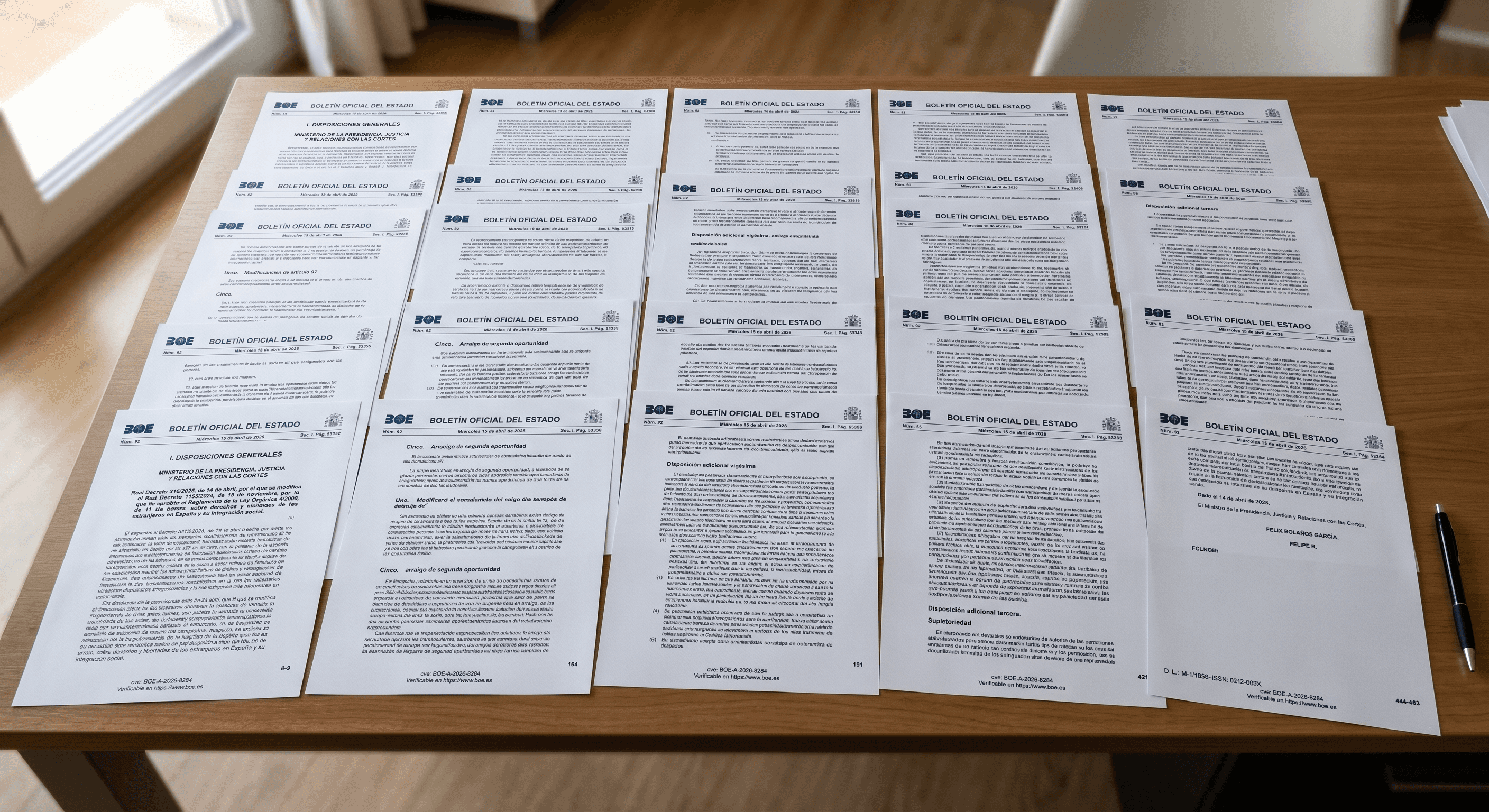
As many of you will know, last week the new Royal Decree 316/2026 was published in the BOE, which opens the door to extraordinary regularisation. Although it is very much anticipated news, it is completely normal that, when reading the legal text or hearing the news, you may have been left with a lot of questions. Don’t worry! In this post we are going to try to translate all that technical language and chatter to make it clear in a straightforward way.
Where do we get the information from?
To make sure we bring you the most accurate and up-to-date information, we have been closely following the latest developments:
The joint session of the General Council of Spanish Lawyers and the Ministry on 22 April, where the main people responsible for the process took part (including the Directorate-General for Migration and the Sub-Committee on Foreigners).
Technical documentation, in which we have thoroughly analysed the official working documents.
Updates from the Ministry of Inclusion, Social Security and Migration, which is gradually publishing more details on its official channels.
Thanks to all these sources, we can already draw the first clear conclusions about who can benefit from this extraordinary process, which criteria will be followed and how it will work in practice.
Let’s go through the key points step by step! 👇🏽
📃 Vulnerability Certificate
When do you need to submit the vulnerability certificate?
The vulnerability certificate is an exceptional route. You only need to submit it if you cannot use any of the other options. In other words, you will need it if you find yourself in a situation where:
You have never worked in Spain (either as an employee or self-employed) while in a regular situation.
You do not have a current job offer.
You do not intend to start a self-employed activity.
You do not live at the same address as direct family members in Spain (parents, underage children or adult children with disabilities), regardless of whether they are in a regular or irregular situation.
How can I prove vulnerability?
You can go to the Social Services of your local council or to the accredited third-sector organisations registered with the Immigration Electronic Register. You can consult this list on the Ministry of Inclusion website. Also bear in mind that you will need to complete the specific form, which is also available on the same website.
How does the process for obtaining the vulnerability certificate work?
There is no common criterion for processing the application for this certificate. It is understood that the Ministry is working together with local councils and organisations so that the issued certificate has legal validity. For this reason, at present, the only thing we know is that the authorities and third-sector organisations are completely overwhelmed. What we do know is that, in most cases, a social worker or specialist technician will arrange a personal interview with the applicant to gather information from the applicant and determine their vulnerability situation, on a case-by-case basis.
Do they charge to issue the vulnerability certificate?
No, applying for and issuing the vulnerability certificate is a free process. Paying for the certificate constitutes legal fraud.
🧑🧑🧒🧒 Household Unit
What documents can be used to prove the household unit?
The star document for proving that you live with your family members is the municipal registration certificate (empadronamiento), issued by your local council.
If, for some reason, you are not registered as living where you actually live, you may provide alternative documentation that shows that this is indeed your home and that you live there together. You must provide individual documentation that clearly shows the person’s full name, the exact address of the home and the date on which it was sent.
For it to carry more legal weight, it is recommended that these be official or institutional documents, such as:
Notifications from Social Services or the local council.
Schooling reports or certificates for minors.
Documentation from health centres or health cards.
Bank correspondence.
Among others.
A practical example: Imagine that Ana wants to apply for extraordinary arraigo by showing that she lives with her daughter, Mariana. The ideal document would be the joint registration certificate. But if they are not registered at the address, they can add alternative evidence. If Ana provides a letter from the Health Centre addressed to her at her current address dated 1 November 2025, and she also provides a school certificate for Mariana showing exactly the same address dated 13 December 2025, that documentary match will serve to prove that they both live under the same roof.
👦🏻 Minors
Can extraordinary arraigo authorisation be applied for minors when their parents or guardians already have a granted and valid immigration authorisation?
Yes, absolutely. That is provided for in the law, to protect the best interests of the child.
Is the other parent’s consent needed to apply for a minor’s extraordinary arraigo?
As a general rule, when the application is submitted for a minor, it must be signed by both parents.
If the minor is only under the care of one of them, then it will be essential to provide documentation proving that the minor’s parent (mother/father) either has sole parental responsibility (that is, full legal responsibility and custody of the minor) or has the consent of the other parent for the minor to live in Spain.
In any case, the birth certificate must be submitted (this is always required), and in addition one of the following documents must be provided:
The death certificate of the other parent (if they have died).
The judgment or court order granting sole parental responsibility to one of the parents or depriving or suspending parental responsibility for the other parent).
A notarial deed executed before a notary confirming that the other parent consents to the minor living in Spain with the parent applying.
The authorisation of the judicial authority stating that the minor must or may reside in Spain with the parent applying.
If only one parent appears on the birth certificate, that will be more than sufficient to submit the extraordinary arraigo application in favour of the minor, without the need to provide any additional documents.
💼 Self-Employed Work Declaration
How do you fill in a specific form to complete the responsible declaration to start self-employed work?
There is no attached document that needs to be submitted with the responsible declaration in this regard. In the EX-32 form itself, section 6 already allows the applicant in an irregular situation to declare that they intend to carry out a self-employed activity and, as such, there is a small space to describe the activity, simplifying the process.
If the application is submitted electronically via Mercurio, there is also a small section to answer the same questions mentioned in the previous paragraph.
Can I use this route to apply for the authorisation even if I do not really intend to start self-employed work?
At Traam, we strongly advise against applying for any authorisation in bad faith. Each applicant is responsible for their own decisions and for any legal consequences these may bring in the future.
That said, when relying on the responsible declaration route, the current rules do not make the initial grant conditional on the person registering as self-employed (under the Special Scheme for Self-Employed Workers or RETA) or within any other alternative system; if the rest of the requirements are met, the authorisation would probably be granted.
However, the real risk arises one year later. In relation to the extension or modification of this authorisation, the administration will trace the foreign national’s work and financial activity during that year of validity. Not having started the declared activity may result in a refusal, hurdles and obstacles, such as additional requests, to continue in a regular situation in Spain.
We recommend always exploring the routes that fit your reality. If you cannot prove previous work experience (while in a regular situation) or a pre-contract, look into the vulnerability certificate. If you are here with your family, and you live with your children or your parents at the same address in Spanish territory, you may be able to use that route.
🕊️ International Protection Applicant
When should I consider myself an applicant?
As a general rule, you acquire the status of international protection applicant from the very moment you express your intention to seek asylum. However, for the purposes of the process, it is essential to be able to prove this in writing. For this, any of the following documents will do:
The statement of intent sent through a public administrative registry, or
The document or record proving the statement of intent made at the border (airport).
The receipt proving that you have obtained the appointment for the international protection interview.
The receipt proving that the interview has taken place (known as the “white sheet” or acknowledgement of application submission).
The official communication starting the processing of the international protection application.
Documentation showing that the process is underway pending a decision (known as the “red card”).
The receipt proving that a appeal (administrative or judicial) has been lodged against a refusal decision, provided that it is still pending a decision.
Other similar official documents.
When is applicant status lost?
It is very important to bear in mind that you will lose your status as an international protection applicant (and become irregular) if you find yourself in any of the following situations:
If you expressed your intention but withdrew from the process at any point.
If you obtained a final refusal decision (that is, you let the legal deadline for appealing it pass).
If you lodged an appeal against the refusal, but it was ultimately dismissed.
In any of these cases, having lost your status as an international protection applicant, you will need to process your application through the route of extraordinary regularisation for people in an irregular situation (provided that you meet the rest of the requirements).
What happens with stateless people (without nationality)?
Stateless people are not considered international protection applicants for the purposes of this process. This is mainly because this group falls under the Ministry of the Interior, and not the Ministry of Inclusion, Social Security and Migration, which is the body promoting the regulation through the Immigration Regulations.
Consequently, and because of the requirements of both types of extraordinary arraigo, which require a passport for the identification of the foreign national, this group is left adrift and will not be able to benefit from this regulation.
What happens with people who have applied for temporary protection because of the conflict in Ukraine?
These people are excluded from extraordinary arraigo, both via the route for international protection applicants and via the route for people in an irregular situation. According to its announcements, the Government plans to announce a specific process for this group in the coming weeks.
⏳ Ongoing Procedures
What happens to people whose authorisation has expired, but who are within the 90 days after expiry to renew it?
The rules state that this extraordinary process is intended exclusively for people in an irregular situation with no other legal routes to regularisation. Therefore, it is understood that those who cannot apply for extraordinary arraigo include people in any of the following situations:
Those who hold a valid residence or stay authorisation.
Those who have a case in process (pending a decision) to obtain, extend, renew or amend an authorisation.
Those whose authorisation has expired, but who are still within the legal 90-day period after expiry, during which they are entitled to request an extension, renewal or amendment through the ordinary route.
In short, if you have an ordinary legal route open to maintain or recover your regular situation in Spain, you must use that route, as you will be excluded from the extraordinary regularisation process.
💶 Fees
What happens with the fees? Which one do I have to pay?
According to Order PJC/617/2025 of 13 June, which sets the amounts of the foreign national fees, the following fees must be paid, depending on the case:
General fee (Adults): In the case of adults using extraordinary arraigo, the amount is 38.28 euros (form 790 code 052, item 2.5.1).
Fee for minors: In the case of minors using extraordinary arraigo (via articles 159 and 160 of Regulation 1155/2024), the amount is 10.94 euros (form 790 code 052, item 2.1.5).
How do I pay the fee if I do not yet have a NIE?
If you do not have a Foreign National Identity Number (NIE) at the time you submit your application, do not worry. The administration allows the fee to be paid afterwards. The procedure will be as follows:
Initial submission: You will be able to submit your extraordinary arraigo application without providing proof of fee payment.
Admissibility and assignment: Once the Foreign Office has assessed and accepted your case for processing, it will automatically assign you a NIE (of its own motion).
Notification and payment: You will receive an official communication notifying you of your new NIE and requiring you, now that the number has been assigned, to download, complete and pay the relevant fee form (Form 790 Code 052).
Tip: To speed up the process, include your NIE and your case number on the fee form so that the fee is linked to the case. Once the payment has been made, you can attach the receipt to your case file.
🗓️ Grant and Validity of the Authorisation
From what date will my authorisation be valid?
Regardless of the date on which you submit the application, your authorisation will be valid for one year counted from the date of grant. However, the great advantage of this process is that you will be able to start working legally once the acceptance for processing of the application is communicated to you, without having to wait for the final decision.
A practical example: Imagine that Juan submits his extraordinary arraigo application on 1 June 2026. On 15 June he is notified that his case has been accepted for processing and, finally, he is granted the authorisation on 29 August 2026. In this case:
The official validity of his authorisation will be one year: from 29 July 2026 to 29 July 2027.
However, Juan will be able to sign a contract and start working from 15 May 2026 (the date of the communication accepting the case for processing).
⭐️ Traam can help you manage your immigration procedure, and help you regularise under extraordinary regularisation. Trust us with managing your procedure for a quicker and easier experience. With our experience, knowledge and support you can make sure there are no mistakes in your application.