Guide: report on school enrolment of minors in Spain
A report that is not only a requirement for certain types of authorisations, but also a legal mechanism to protect the child. We explain what it is, how to obtain it and what it must contain.

5 mins
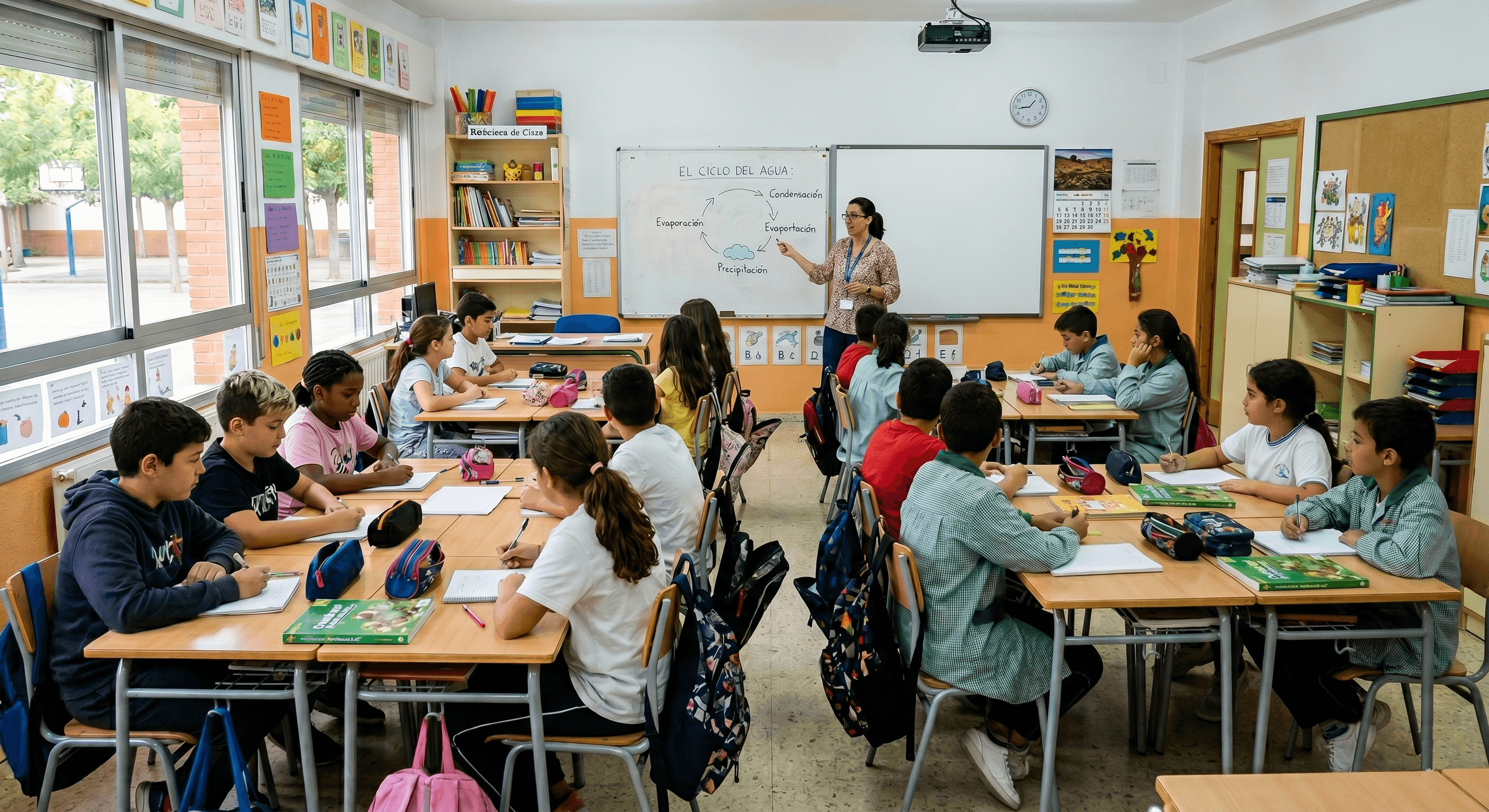
In various immigration procedures, the interested party is asked to submit this document in respect of their minor children in their care when they are in Spain. The aim is for the Immigration Office to be able to verify strict compliance with the duty of compulsory schooling for children aged between 6 and 16 who reside in Spain.
🤔 For which authorisations is it required?
Current regulations require proof of the schooling of dependent minors in various procedures, such as, for example, by way of example and not limited to, in the following cases:
Temporary residence through family reunification: This is required both in the initial application (in the event that the sponsor already has other minor children in their care living in Spain) and, of course, when it is renewed.
Renewal of the non-lucrative temporary residence authorisation.
Renewal of the temporary residence and employment authorisation for employed work.
Renewal of the temporary residence and employment authorisation for self-employment.
National long-term residence authorisation: When the foreign national applies for this permanent authorisation on the basis of their five years of continuous previous residence.
Residence authorisations for minors: When applying for specific residence permits for children (accompanied) of residents, whether they were born in Spain or not born in Spain.
📑 What exactly is the minor's school enrolment report?
It is an official document certifying that a minor of compulsory school age (which in Spain ranges from 6 to 16 years old) is enrolled and attends an educational establishment in the country regularly, whether public, state-subsidised or private. Its purpose is to demonstrate the minor's integration and compliance with the parents' duties.
🏫 Who issues it and where is it requested?
The regulations establish that this report falls within the remit of the educational authorities of the Autonomous Community corresponding to the minor's place of residence. In general, it is requested from the Department of Education or its regional offices.
As each regional government has its own procedures, the process and documentation may vary. However, in practice, the process is usually divided into these two fundamental steps:
Phase 1. Obtaining certification from the educational establishment
The minor's legal representative must request from the school office (whether it is publicly owned, private or state-subsidised) the issue of an official certificate of enrolment and attendance. This document must reliably prove that the minor is enrolled in the current academic year and that they comply with the duty of regular attendance, an essential requirement for minors of compulsory school age.
Phase 2. Issuance of the report by the competent regional authority
Once the certificate from the school has been obtained, the formal school enrolment report must be requested from the competent body of the Autonomous Community (usually the Department of Education or the Directorate-General for Immigration, depending on the region). That authority will validate the minor's school situation in order to issue the mandatory report required by immigration regulations in renewal procedures or applications for residence authorisations.
💡 Our recommendation
The declaration of responsibility and consent for data verification.
However, there is another much quicker and more streamlined option, which we at Traam strongly recommend. This consists of meeting this requirement by submitting a responsible declaration (also attached as a resource at the end of this blog), using the official template provided by the Ministry of Inclusion, Social Security and Migration, instead of the minor school enrolment report as such. Through this standard declaration form, the parent or legal guardian sets out two fundamental points:
They confirm under their responsibility that the minor is indeed enrolled in school.
They give their express consent for the Immigration Office to check this data ex officio (that is, for the officials themselves to verify the enrolment automatically and electronically through Education databases).
🔄 Alternative documentation: Certificate from the educational establishment
In the absence of the official report from the Autonomous Community, and if you do not wish to give consent for the electronic check, you can provide an enrolment and attendance certificate issued and stamped directly by the school or college office.
⚠️ Even if you provide the school certificate, the Immigration Office reserves the right to ask you for the official report from the Autonomous Community if the computer systems fail or if the data are not conclusive. For this reason, we do not recommend this route.
🔍 What should the school enrolment report contain?
Although the format may vary slightly depending on the Autonomous Community, for the document to be valid before Immigration it must reliably certify the following points:
Child and school details: Full identification of the pupil (first name, surname, date of birth, NIE if they have one) and the official details of the educational establishment (centre code, address and stamp).
Enrolment: It must confirm that the minor is enrolled in a specific academic year of primary or compulsory secondary education.
Regular attendance: This is the most important point. The report must state that the minor attends class regularly and does not have episodes of unjustified absence.
Signature of the competent authority: It must be issued by the corresponding regional body (usually validating a prior certificate from the school head).
👀 What happens if I do not submit this requirement?
If, when submitting your immigration application (initial or renewal), you do not attach the report, do not submit the declaration of responsibility with consent for ex officio consultation, and do not provide the school certificate, the Immigration Regulations lay down the following safeguard procedure:
Notice to the authorities: The Immigration Office will bring it to the attention of the competent educational authorities that the minor's schooling has not been proven.
Formal notice: You will be expressly and in writing notified of the absence of this document.
One-month deadline: You will be given a one-month period in which to submit the relevant report.
Final consequence: If after that month you have not provided the report proving effective schooling, the decision will be negative and your authorisation will not be renewed.
🧒🏻 What if I have a dependent minor and they are not enrolled in school?
In Spain, schooling is an unavoidable duty for parents or guardians of children between 6 and 16 years old. Failing to comply with this obligation has serious consequences in two areas:
Immigration applications refused: Immigration regulations establish schooling as an essential requirement for the granting of certain initial authorisations or renewals. If the minor is not enrolled in school, the outcome of the immigration authorisation application is put at risk and, therefore, so is the applicant's continued stay in Spain.
Legal consequences and child protection: The Immigration Office, when there is no proof of schooling or it detects school absence, is under a legal duty to bring this circumstance to the attention of the competent educational authorities (Departments of Education) so that they can begin the relevant inspection and monitoring action. This notice acts as a mechanism to protect the best interests of the child; if the situation of non-schooling is not regularised after the official request, the educational authorities will refer the case to the Social Services Department of the relevant local council or to the Public Prosecutor's Office.
💡 In any event, if you are dealing with an immigration procedure, make sure that your minor child (6-16 years old) is enrolled in school in Spain. If not, the child should be enrolled as soon as possible so as not to have problems either with the immigration authorisation or, in the worst case, with social services.
Once the minor is enrolled, we recommend that you submit, together with the immigration application, the declaration of responsibility (with consent to check the data) so that the Immigration Office can check the minor's schooling ex officio or, where appropriate, the minor's school enrolment report issued by the competent authorities.
If you have not yet enrolled the minor, but you must submit the immigration application now, then we recommend that you submit the immigration file without the documentation relating to the minor's schooling, and in parallel carry out the procedures to enrol them as soon as possible. Once that has been done, you can then submit either of the two documents mentioned in the previous paragraph to complete the application.
⭐️ Traam can help you manage your immigration procedures, and help you navigate confusing requirements and complex processes. Trust us with managing your procedure for an easier and faster experience. With our experience, knowledge and support, you can make sure there are no errors in your application.
📁 Resources
📄
Responsible declaration template