Guide: The Vulnerability Certificate
We provide information and answer questions about the vulnerability certificate required in certain cases for the purposes of the exceptional regularisation process of 2026.

5 mins
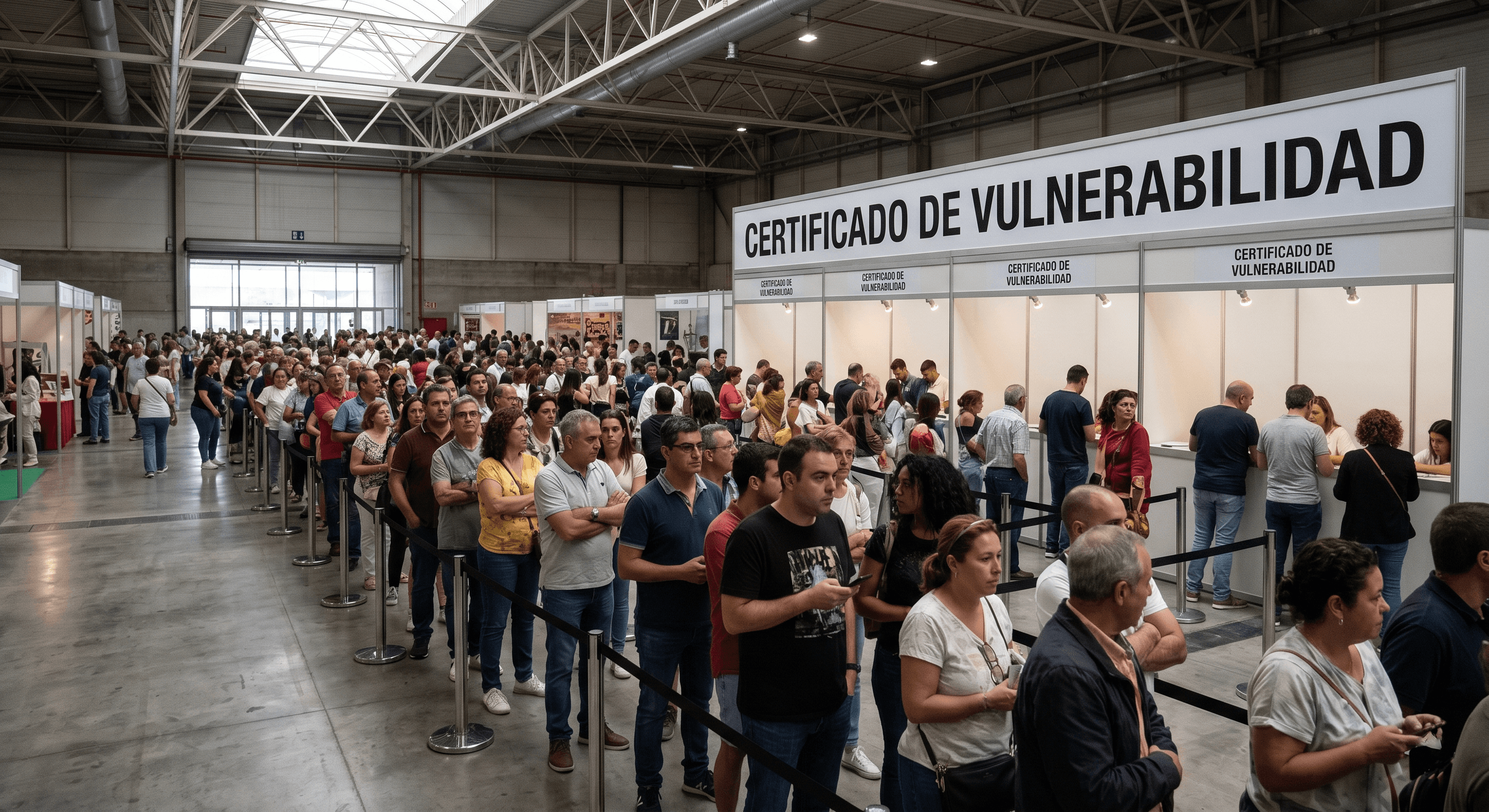
Today we think it is useful to look a little more closely at the vulnerability certificate that is requested, in some cases, to apply for the extraordinary regularisation recently approved by the Spanish Government and now included in Immigration Regulations 1155/2024.
What is the vulnerability certificate?
It is a document issued by social services or authorised entities that certifies a situation of social, economic or personal risk, which is required to apply for the temporary residence authorisation on exceptional grounds (extraordinary regularisation).
When do you have to provide the vulnerability certificate?
The vulnerability certificate must be submitted when the applicant:
Cannot prove that they have worked legally in Spain.
Does not have a job offer
Does not intend to start self-employment
Does not have family ties with children or parents, who form part of the same family unit (that is, who live together in the same household), in Spain.
Which bodies can it be requested from?
You can request it from:
The social services departments of local councils.
Social organisations and trade unions registered in the Electronic Register of Foreigners' Collaborators. You can consult them at the following link.
We recommend going to the council or an organisation/NGO in the applicant's province of residence.
Is it necessary to have the registration certificate to apply for the vulnerability certificate?
Exactly, to verify that the applicant is requesting the vulnerability certificate in the locality where they live, it appears that the council has so far been asking for the registration certificate (or proof of registration).
However, as not all applicants have been able to obtain it and the administration is currently overwhelmed when it comes to requesting the registration certificate, a way is being enabled to obtain the vulnerability certificate without needing to provide the registration certificate.
It should also be made clear in this regard that, although the registration certificate is a good document to prove residence in Spain since before 1 January 2026 and continuous residence for a minimum period of 5 months in the national territory, it is not, strictly speaking, a requirement to have it in order to apply for the temporary residence authorisation on exceptional grounds (extraordinary regularisation), because other documents may alternatively be submitted to prove compliance with the residence requirement.
Does the vulnerability certificate need a specific format?
Yes, there is a specific model that administrations or entities must use to certify vulnerability. Below we leave the link. However, we understand that some councils are using their own template, and this should likewise be accepted by the relevant foreigners' office. In any case, we recommend that applicants themselves bring a printed copy of the standard model to the appointment to request the vulnerability certificate.
What does the procedure involve?
The procedure consists of being seen by an officer from the local council's social services department or any social worker or technical staff from the registered organisations and trade unions so that they themselves can assess the applicant's level of vulnerability. Normally, a small personal interview is held to assess the applicant's situation. We recommend that the applicant bring to the appointment all the documentation mentioned in the previous section to ensure success.
Do you need an appointment in advance to request the vulnerability certificate?
The short answer is: It depends on where you go (the council or a social organisation) and on where you live. Due to the high volume of applications, each body has set up its own mechanisms to avoid bottlenecks.
If you apply through authorised Social Organisations or Trade Unions
Each NGO, foundation or union registered in the official register has its own service protocol. However, in practice, the vast majority require you to book an appointment in advance (by phone, email or through their website) before attending their offices in person. We recommend checking the Ministry's official list, choosing the organisation operating in your area and contacting them beforehand to confirm their service system.
If you apply through the local councils
Yes, as a general rule, an appointment is required. The vast majority of councils require you to book a slot to be seen by the municipal Social Services. We recommend checking your council's website or calling the citizen service phone line (such as 010).
Special arrangements in large cities: Faced with the high volume of applications, the administrations of large cities have changed the general rules and have introduced dedicated arrangements to avoid collapse:
📍 In Madrid
The Madrid City Council has a different system. You should not book a direct appointment with Social Services (in fact, the council warns that it will cancel ordinary appointments booked for this purpose). They have created a single, centralised procedure:
The single form: You must submit a specific document called "Application for a vulnerability report for the extraordinary regularisation of migrants 2026".
How is it submitted in Madrid?
Online: Through the City Council's Electronic Office (if you have electronic identification).
In person (without an appointment): By delivering the form directly to the municipal Registration Offices that accept walk-ins.
In person (with an appointment): At the Citizen Services Offices of Línea Madrid.
Once you register this official request, the City Council will forward it internally to the Social Services Centre in your district so that they can process your report.
📍 In Barcelona
The Barcelona City Council has established a strict two-step system. You cannot go directly to request the certificate without completing the first step:
Get the appointment ticket. Hall 2 of the Fira de Barcelona (Montjuïc) has been made available from 8:00 to 22:00 exclusively for handing out appointment tickets. (Note: the certificate is not issued at the Fira.) You can also request the ticket by calling 93 153 28 15 or through the electronic office.
Attend your appointment. The ticket will assign you a day and direct you to one of the four municipal points expressly enabled to review your documents and issue the certificate. These are:
OAC Sant Miquel: Plaça de Sant Miquel, 4.
OAC Monumental: Calle Sicília, 216 (also open on Saturdays).
SAIER (Service for the Attention of Immigrants, Emigrants and Refugees): Calle Tarragona, 141.
Comprehensive Support Point Miquel Bleach: Calle Miquel Bleach, 24 (Sants-Montjuïc district).
Does this procedure have any cost?
No, it will always be 100% free. Charging for it constitutes fraud.
Additional information
Public sources
Website of the Ministry of Inclusion, Social Security and Migration: Extraordinary regularisation for migrants.
Website of the Ministry of Inclusion, Social Security and Migration: The vulnerability certificate model is available on the Ministry of Migration's website.
Website of the Madrid City Council: Vulnerability certificate/report - Regularisation of migrants 2026.
Website of the Barcelona City Council: Extraordinary regularisation of migrants: key points and route to apply.