Legalisation and Translation of Documents
It is a topic that brings together many overlapping concepts; Hague Convention, MAEUEC, sworn translators, embassies and consulates... We explain it all, simply.

10 mins
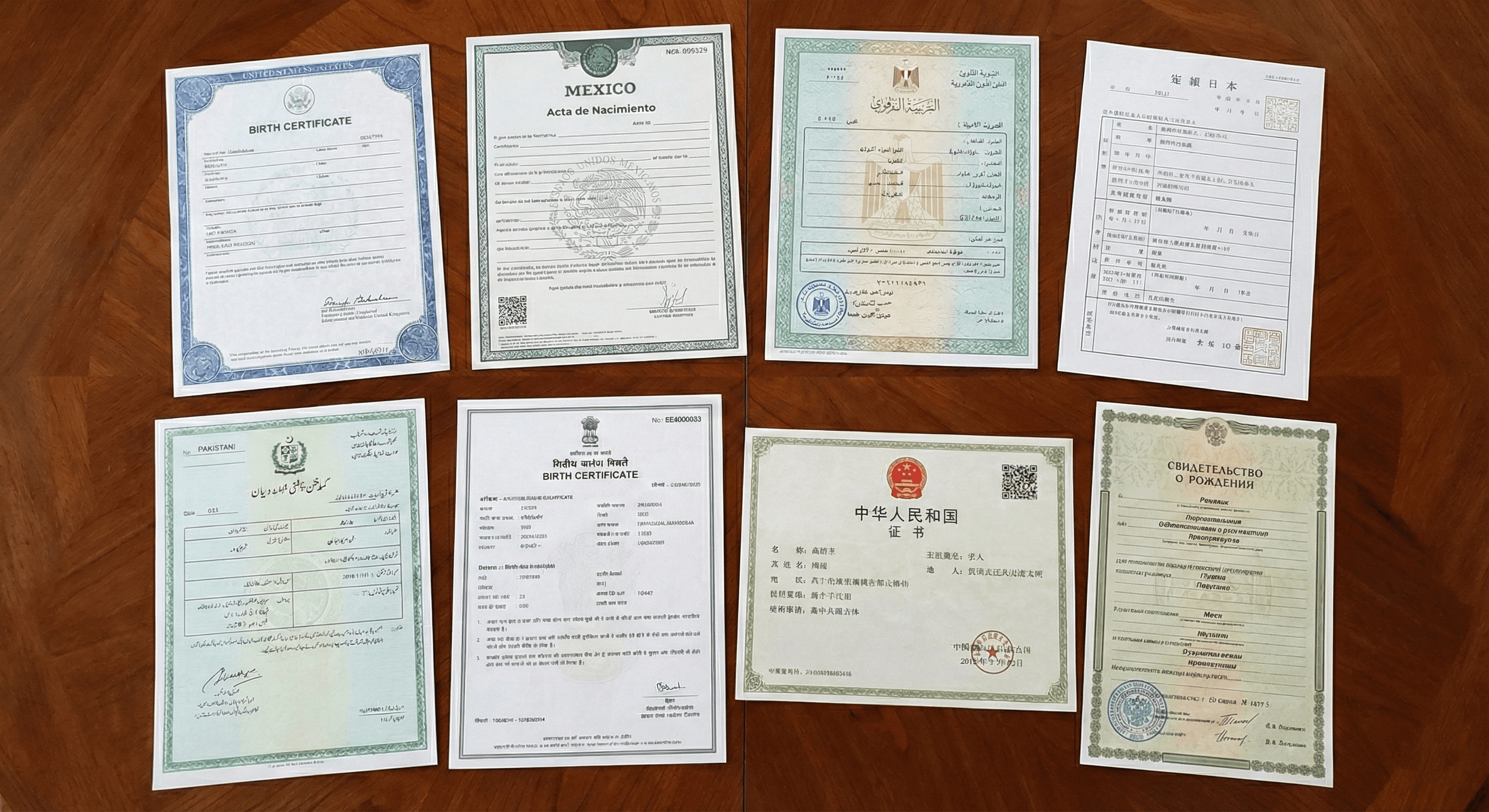
We address one of the topics that generates the most doubts in the area of immigration: the legalisation and translation of documents. It is equally important to know what documents need to be submitted as to know how they should be presented and to ensure they meet the requirements for their legal validity in Spain.
To make this guide truly practical, we will focus on the most common scenario: a document issued by a foreign administration that must have effect before the Spanish public authorities (such as the Immigration Offices).
🎬 Introduction
What does it consist of?
While we are clear about what it means to translate, in many cases, we are less clear about what it means to legalise. Legalisation is an administrative procedure that certifies the authenticity of signatures and seals contained in a public document. A public document is one issued by a State or competent authority. As a more technical note, legalisation does not validate the content of the document (what it says), but rather the authority that issues it (who signs it).
What documents need to be legalised and translated?
As a general rule, and to simplify as much as possible, foreign public documents (i.e., those issued by the public authorities of other countries different from Spain) must be legalised. Likewise, all documents, whether public or private, that are not in Spanish must be translated.
Summary Table
Legalisation/Apostille | Translation | |
|---|---|---|
Foreign public documents | Yes, always (unless exempted by treaties). | Yes, if not in Spanish. |
Private public documents | No. |
🏛️ The Legalisation of Foreign Public Documents
🏷️ Classification by the Origin of the Document
Regarding legalisation, we must distinguish between two types of foreign public documents, depending on where they were issued:
Group 1
Foreign documents issued abroad, that is, outside of Spain. Those authorised by a public authority in their country of origin. This includes documents issued remotely via the internet through the electronic offices of the corresponding administration.
Example: A marriage certificate issued by the Civil Registry of Bogotá, Colombia.
Group 2
Foreign documents issued in Spain. It is common to forget that diplomatic missions (the “embassies”) and consular offices (the “consulates”) of foreign countries in Spanish territory also issue public documents that are considered foreign.
Example: A criminal record certificate issued by the General Consulate of Colombia in Madrid.
This distinction is key, as the procedure for both documents to have validity before the Spanish administration can vary substantially.
🔀 The Different Methods of Legalisation, Depending on the Origin of the Document
→ Group 1
If the document belongs to the first group, i.e., it is a foreign document issued abroad (including those issued remotely via the internet), we have two options:
1. Via Hague Apostille
Documents issued outside of Spain by authorities from countries that are signatories of the Hague Convention
What is the Apostille of The Hague and what does it consist of?
The Apostille of The Hague is the easiest and most convenient method. In theory, it is an exemption method from legalisation; however, as such, it is a bureaucratic procedure, which is why we often refer to it as fast-track legalisation.
The apostille procedure consists of placing an apostille or notation on a public document, or an extension of it, that certifies the authenticity of the signatures of the public documents.
Who can benefit from the Apostille of The Hague system?
It only applies between signatory countries of the XII Hague Convention, dated October 5, 1961; therefore, only those who have a document issued by a country that is part of the Hague Convention can request the apostille, and this type of legalisation is valid only if the apostilled document is presented in another country that is also part of the Convention. Fortunately, Spain is part of the Convention and recognises the Apostille from other signers.
Where can the apostille be requested?
It must always be requested in the country where the document is issued. In some cases, it can also be requested online from the competent authority. Below, you can check the competent authority to issue the Apostille of The Hague in each country that is part of the Convention.
What documents can be apostilled?
It is essential to note that not all public documents can be apostilled. The website of the Ministry of the Presidency, Justice and Relations with the Courts indicates which ones can and which ones cannot.
Can be apostilled: judicial, administrative, and notarial documents.
Cannot be apostilled: documents issued by diplomatic or consular officials (these belong to group 2 and must be legalised via MAEUEC).
2. Via Diplomatic Legalisation
Documents issued outside of Spain by authorities from countries that are not part of the Hague Convention
What is diplomatic legalisation?
If your document is foreign issued abroad and your country is not a part of the Hague Convention, this is your path. The website of the Ministry of Foreign Affairs, European Union and Cooperation (hereinafter, MAEUEC) defines diplomatic legalisation as the process to provide legal validity to public documents in a state different from the one that issues them and, in this case, the procedure consists of two phases that give meaning to its name.
What are the phases of diplomatic legalisation?
Diplomatic legalisation has two phases:
The first phase consists of legalising the document before the Ministry of Foreign Affairs of the same country that issued it.
The second phase consists of legalising the document at the Spanish embassy or consulate in the foreign country.
→ Group 2
Foreign documents issued in Spain. If the document belongs to the second group, that is, it is a foreign document issued at a consulate or embassy in Spain, we only have one option.
Via MAEUEC
Any documents issued by diplomatic or consular officials of foreign countries issued within Spanish territory cannot be apostilled nor follow the diplomatic legalisation route for them to have validity in Spain.
These documents must be legalised directly by the Legalization Service of the Ministry of Foreign Affairs, European Union, and Cooperation (MAEUEC) of Spain. Without the stamp of this Spanish ministry, the document issued by the foreign embassy or consulate in Spain will not be valid before other public agencies in Spain.
🗣️ The Translation of Foreign Public and Private Documents
🔣 The Different Methods of Translation
Article 17 of the Royal Decree 724/2020, which approves the Regulation of the Language Interpretation Office of the Ministry of Foreign Affairs, European Union, and Cooperation defines what is considered official translation.
1. Sworn Translator Recognized by MAEUEC
This route is the most recommended, as it is the quickest and simplest because it does not require the translation to be subsequently legalised before MAEUEC.
Process: Verify the availability of translators in your language. Check the official list of Sworn Translators of MAEUEC to confirm that there are translators who can translate from your language to Spanish. Contact them via email or phone to request a quote, availability, and documentation needed to carry out the translation.
Clarification: They will most likely not require the original copy of the document; they will only need a certified copy of the document to carry out the translation, making the process much smoother and more economical.
Reminder: Keep in mind that there are no sworn translators for all languages. If your language is not on the list, you will need to proceed to translate via option 2 or 3, which we will explain below. For example, there are no sworn Vietnamese-Spanish translators.
2. Translation at the Spanish Embassy or Consulate in the Foreign Country + MAEUEC Legalisation
Process: You can request translation at the Spanish embassy or consulate in the foreign country that issued the document in question, as long as translation services are offered.
Clarification: Keep in mind that not all Spanish embassies/consulates around the world have translation services.
Reminder: Be aware that this translation must ultimately be legalised before the MAEUEC in Madrid, Spain. We will explain how this type of translation's legalisation should be carried out.
3. Translation at the Foreign Embassy or Consulate in Spain + MAEUEC Legalisation
Process: You can also request translation at the embassy or consulate of the foreign country that issues the document, in Spain.
Clarification: Note that not all foreign embassies/consulates in Spain have translation services.
Reminder: Similarly, as already applies in option 2, bear in mind that this translation must ultimately be legalised before the MAEUEC in Madrid, Spain.
🖋️ The Legalisation of the Translation
Once you have the translation completed by the embassy/consulate (whether via the second or third method outlined above), the last step is to obtain the seal of the Ministry of Foreign Affairs through the legalisation service of MAEUEC. This procedure is completely free, except for shipping or external management costs, and you can do it in three ways:
1. Remotely:
If you do not live in Madrid, do not know someone in the city you can entrust this to, or do not want to delegate the procedure to a management agency (gestoría), we recommend that you send the original documentation to the same address (C/ General Pardiñas 55, 28006 Madrid) via:
Certified mail: This is the official postal route. It is important to include a prepaid envelope with your address so they can return the document to you.
Private courier: You can hire a logistics company to handle the delivery and pickup.
You can also delegate the procedure, at low cost, to an authorised management agency (gestoría) in your place of residence.
2. In-Person (in Madrid)
If you live in Madrid, have someone trustworthy in the city or prefer to hire a professional to do it for you in person, you have two options:
In person: You can go to the MAEUEC office at Calle del General Pardiñas nº 55 in Madrid, 28006. It is not necessary to make an appointment, and the service hours are Monday to Friday, from 9:00 am to 2:00 pm.
By representation: If you cannot go yourself, anyone you trust, a professional, or an authorised management agency can go to carry out the procedure on your behalf under a power of representation.
🔓 The Exemptions Provided in International Treaties
Finally, we will analyse the exemptions that are provided for the legalisation or apostille procedure in certain public documents, mainly within the EU. This exempts you from the need to legalize these documents, and sometimes, also from their translation.
EU Regulation 1191 of 2016
The EU Regulation 1191 of 2016 is a European agreement ratified by the 27 Member States of the European Union: Germany, Austria, Belgium, Bulgaria, Cyprus, Croatia, Denmark, Slovakia, Slovenia, Spain, Estonia, Finland, France, Greece, Hungary, Ireland, Italy, Latvia, Lithuania, Luxembourg, Malta, Netherlands, Poland, Portugal, Czech Republic, Romania, and Sweden.
According to Article 2.1 of the Regulation, the following certificates/documents are exempt from legalisation:
Birth certificate (does not apply to certified copies of birth certificates).
Certificate of life.
Death certificate.
Marriage certificate.
Civil status certificate.
Certificate of divorce, judicial separation, and annulment.
Certificate of registered partnership.
Certificate of filiation.
Certificate of adoption.
Certificate of residence.
Certificate of nationality.
Criminal record certificate.
According to Article 6 of the Regulation, the following certificates/documentation are exempt from translation, provided that,
They are accompanied by the standard multilingual form annexed to the Regulation.
They are issued by an authority.
They carry the date of issue, signature, and seal or stamp of the issuing authority.
It applies only to:
Birth.
The fact that a person is alive.
Death.
Marriage.
Registered partnership.
The residence or the residence.
The absence of a criminal record.
Vienna Convention of 1976
Articles 1, 6, and 8 of the Vienna Convention of 1976 establish the exemption from legalisation or equivalent formality, as well as translation, when they relate to:
Birth act certifications
Marriage act certifications
Death act certifications
All these certificates must be issued in multilingual format.
The signatory states are Germany, Austria, Belgium, Bosnia and Herzegovina, Bulgaria, Cape Verde, Croatia, Slovenia, Spain, Estonia, France, Italy, Lithuania, Luxembourg, Republic of North Macedonia, Moldova, Montenegro, Netherlands, Poland, Portugal, Romania, Serbia, Switzerland and Turkey.
Therefore, this convention favours the countries highlighted in bold in the previous section, which are not part of the EU and thus cannot benefit from Regulation 1191. However, they can benefit from the Vienna Convention and take advantage of the exemption from legalisation and translation in the public documents of those countries that must be presented in Spain.
Exchange of Notes of Madrid of 1984
The Exchange of Notes of Madrid of 1984 is a convention signed bilaterally between Spain and the USSR (Russia) that establishes that documents related to the birth certificate, marriage, and death, as well as any other certificate that a Civil Registry can issue, may be exempt from legalisation. In this case, the exemption from translation does not apply.
📌 Comparative Table
Legalisation | Translation | |
|---|---|---|
Documents issued abroad (including those issued remotely via the internet) | ||
Recommended Option | Apostille of The Hague *When the issuing country is part of the Hague Convention. | Sworn Translators MAEUEC *When there are sworn translators in that language. |
Alternative Option | Diplomatic Legalisation Two mandatory steps: 1) Ministry of Foreign Affairs of the foreign country. + 2) Diplomatic mission or consular office of Spain in the foreign country. | Diplomatic/Consular Translation Two mandatory steps: 1) Diplomatic mission or consular office of Spain in the foreign country or diplomatic mission or consular office of the foreign country in Spain. + 2) Legalisation of the translation before the MAEUEC. |
Documents issued in Spain (by consulates or embassies) | ||
Recommended option | Legalisation via MAEUEC | Sworn Translators MAEUEC *When there are sworn translators in that language. |
Alternative option | Diplomatic/Consular Translation Two mandatory steps: 1) Diplomatic mission or consular office of the foreign country in Spain. + 2) Legalisation of the translation before the MAEUEC. | |
From Traam, we help you manage all the translation and legalisation required for your immigration procedures. With unlimited consultations from our platform, we guide you to request the correct documentation and then we check it before submitting your case to the Administration. This way, you ensure that everything has been done correctly.