8 Jan 2026
Registered Partnership and Residency in Spain
I am in a civil partnership and want to reside in Spain. How do I do it? How do I certify it?

5 mins
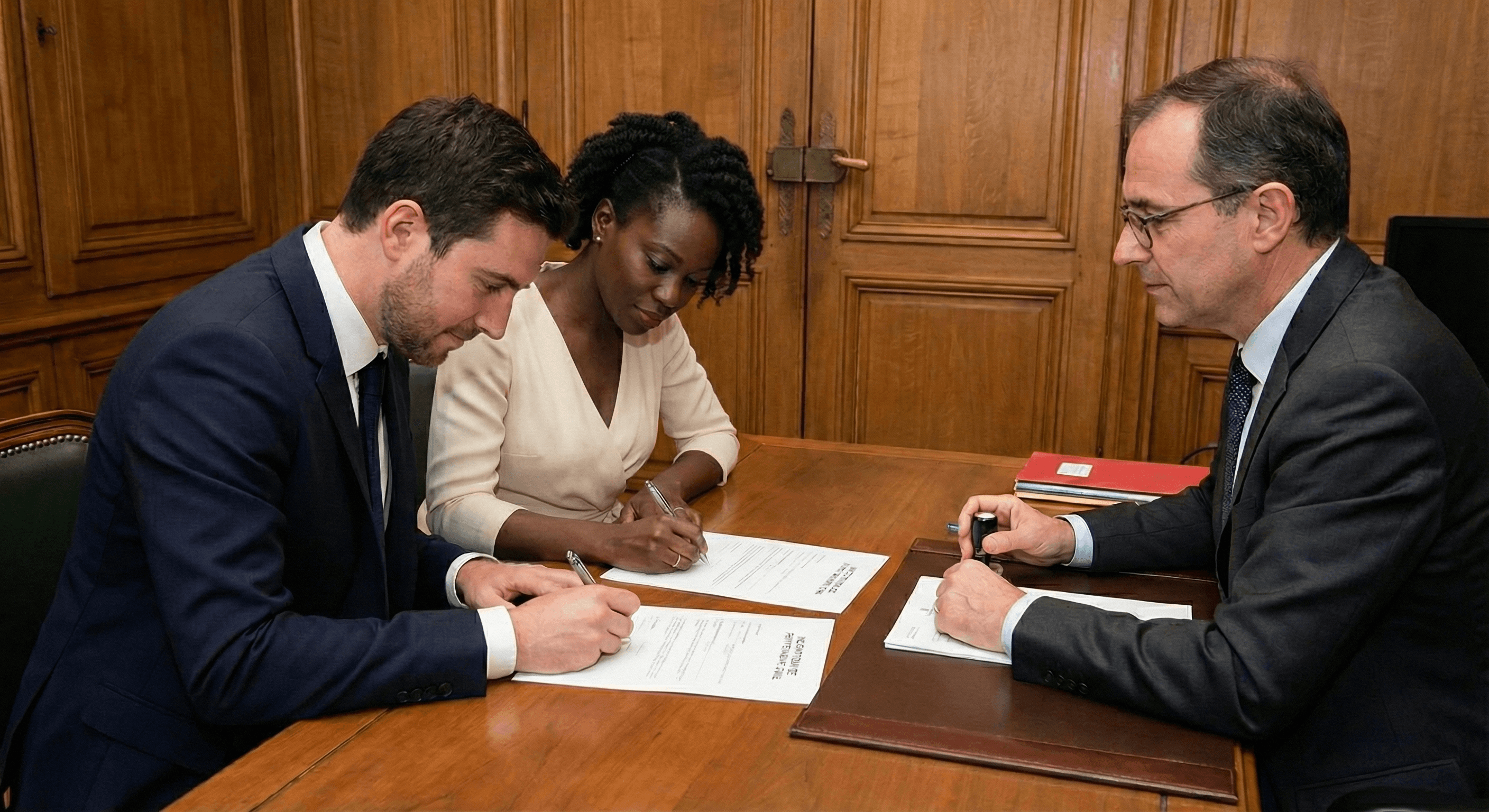
Registered partnerships, civil marriages, or common-law couples (in Spain, pareja de hecho), and the associated residence permits, are among the most consulted procedures in immigration law.
Many believe that if there is no marriage or official registration, there are no rights. But the reality is different. Based on the European Directive 2004/38/EC and its implementing law in Spain, the Royal Decree 240/2007, the right to free movement and family life not only protects the Union citizen but also their family.
Furthermore, the new reform of the Immigration Rules and Regulations, the Royal Decree 1155/2024, has provided for a new temporary residence permit for family members of Spanish citizens.
Therefore, you have several options, let’s take a look at them.
🏡 Who can benefit from this right to reside in Spain?
🇪🇺 Community Regime
Based on European regulations, the law divides couples into two main groups:
Spouses or common-law couples registered in a public registry (Art. 2 Royal Decree 240/2007).
Unregistered common-law couples who can demonstrate a stable relationship and cohabitation (Art. 2 bis Royal Decree 240/2007).
There are other situations that we will not analyse in this blog entry.
The most important thing: This right applies regardless of the nationality of the family member. Now, based on this, one can request:
If the partner is an EU/EEA/Swiss citizen → EU Citizen Registration Certificate.
If the partner is not an EU/EEA/Swiss citizen → EU Citizen Family Card.
Both documents are requested from Spain. However, if you are not an EU/EEA/Swiss national and your country of origin requires a Schengen visa to enter Spanish territory, you can apply for a free visa to come to Spain to apply for the residence card of a family member of a Union citizen once in the country.
🇪🇸 General Regime
Based on Spanish regulations, the law provides that those who may live or reunite with the Spanish citizen are:
Spouse (Art. 94.1.a Regulation 1155/2024).
Registered common-law partner (Art. 94.1.b Regulation 1155/2024).
Unregistered common-law partner (Art. 94.1.c Regulation 1155/2024).
There are other situations that we will not analyse in this blog entry.
It can be applied for from Spain or from the partner's country of origin or current residence. It only applies to couples in which one of the parties is a Spanish citizen.
🧩 What can be requested according to the circumstances?
🇪🇺➕🇪🇺 You are both EU/EEA/Swiss citizens
The EU Citizen Registration Certificate - CUE
If you are both EU/EEA or Swiss citizens (for example: an Italian and a German), there are two possible paths:
Independent Path: Each one applies for their own CUE (the famous “green card or NIE”) as a salaried worker, self-employed, non-worker or student.
Dependent Path: One requests the independent CUE as a salaried worker, self-employed, non-worker or student and the other as a family member of the principal applicant.
🚋 We at Traam can assist you with the CUE process.
💡 Recommendation
If you are a registered common-law couple, there will be no problem if you go the dependent path, proving the registration of the common-law couple in any EU/EEA/Swiss member country.
However, if the registration is in a different country than the EU/EEA/Switzerland or you are an unregistered common-law couple, we recommend applying for two CUEs through the independent path, given that, in such a case, you must:
either register in an EU/EEA/Swiss country as a common-law couple,
or prove that you are an unregistered common-law couple by providing evidence of cohabitation of at least one year or having children together.
🇪🇺➕🌎 EU/EEA/Swiss Citizen + Non-EU Partner
EU Citizen Family Card - TRFC
If your partner is from an EU/EEA/Swiss country and you wish to accompany them to Spain, you must apply for this card. It applies in two scenarios:
That the EU/EEA/Swiss citizen (not Spanish) who comes to reside or is already residing in Spain, reunites with or accompanies or lives in Spain with their registered or unregistered common-law partner who is not an EU/EEA/Swiss citizen.
Example: A French citizen and their Colombian partner. They lived in Germany, where they were registered as a common-law couple and now move together to live in Spain. The Colombian person will apply in Spain for an EU Citizen Family Card, since their partner is French.
Example: A Finnish citizen residing in Spain for the last 10 years, meets a Peruvian man in Spain, they fall in love, become a common-law couple in Spain, and he applies for an EU Citizen Family Card.
That the citizen is Spanish, but is exercising their right to free movement within the EU, that is, that you have recently lived in another EU/EEA/Swiss country, and you move together to live in Spain.
Example: A Spanish citizen and their Colombian partner. They lived in Italy, there they were registered as a common-law couple, and now they move together to live in Spain. The Colombian person will apply in Spain for an EU Citizen Family Card since their partner is Spanish but they are exercising their right to free movement within Europe.
⚠️ This is the only situation in which a foreigner can apply for a TRFC with a Spanish citizen. ⚠️
🚋 We at Traam can assist you with the TRFC process.
💡 Recommendation
If you are a registered common-law couple, there will be no problem if you apply for the residence card of a family member of the EU citizen, proving the registration of the common-law couple in any EU/EEA/Swiss member country.
However, if the registration is in a different country than the EU/EEA/Switzerland or you are an unregistered common-law couple, we recommend registering it in Spain, through the registry of your Autonomous Community, or in a EU/EEA/Swiss member country, given that, in such a case, you must prove that you are an unregistered common-law couple by providing evidence of cohabitation of at least one year duration or having children together.
🇪🇸➕🌎 Spanish Citizen + Non-EU Partner
Temporary residence permit for family members of Spanish citizens - ARFCE
This is the major novelty of the new Immigration Rules and Regulations that came into effect in May 2025. It is the ideal route if your partner is Spanish and you have not lived together in another EU country recently or if you have lived in a third country that is not a member of the EU/EEA/Switzerland. If you have lived in another EU country, we recommend taking the previous route, the TRFC.
Example: A Spanish woman and her Honduran partner. She is Spanish and has always lived in Spain, she falls in love with a Honduran guy in Spain. They become a common-law couple, and he applies for a temporary residence permit as a family member of a Spanish citizen! We will see it below.
🚋 We at Traam can assist you with the ARFCE process.
💡 Recommendation
If you are a registered common-law couple in any EU/EEA/Swiss member country (that is not Spain) and have lived in another EU country, it may make more sense to apply for a TRFC.
If you are a registered common-law couple in a country different from the EU/EEA/Switzerland or in a third country, you must:
either register in Spain, in the registry of your Autonomous Community, as a common-law couple,
or prove that you are an unregistered common-law couple by providing evidence of cohabitation of at least one year duration or having children together,
and follow the path of temporary residence permit for family members of a Spanish citizen.
🧐 How Is A Common-Law Couple (Registered And Unregistered) Accredited?
Honestly, it is always much better, and less cumbersome when processing a residence permit, to be a registered common-law couple.
🖇️ If You Are Already A Registered Couple
You must present the certificate from the Registry of Common-law Couples.
Important: The registration must be done in a public registry in Spain or in an EU/EEA country.
⏳ If You Are Not Yet A Registered Common-Law Couple
⭐️ We recommend registering it! ⭐️
The registration of common-law couples is the competence of the Autonomous Communities. We recommend that you contact the competent authority in your locality or a notary in the area and inform yourselves. Generally, in most cases, there are the following two main paths to register the couple:
Public registry path: The procedure is free but tends to be slower, registration is immediate at the time of processing. You need to check the requirements of each Autonomous Community, for example:
In the Community of Madrid: They require joint registration for 12 months (unless you have children together). Without that year of prior cohabitation, you will not be able to register. Start here to register the common-law couple in the Community of Madrid.
In Catalonia: They do not require a minimum duration of registration. It is sufficient to be jointly registered at the time of application (or have children together). Start here to register the common-law couple in Catalonia.
‼️ 👀 You must register in the Autonomous Community where you are going to live and request the corresponding residence card (TRFC or ARFCE). 👀 ‼️
Notarial path (public deed): This is the fastest route, costs money, and the couple may take time to be registered. Here we must distinguish whether the act is constitutive or declarative.
Constitutive effect: The notarial deed grants you the status of a common-law couple automatically. This is the case in…
Aragon
Catalonia
Balearic Islands
Navarre
Declarative effect: The notarial deed does not automatically grant the status of a common-law couple. The notarial deed is merely a “statement of intent,” and one of the possible requirements before registration. In these cases, only registration in the Community's registry will have legal effects. This is the case in…
Andalusia
Asturias
Canary Islands
Cantabria
Castilla-La Mancha
Castilla y León
Ceuta and Melilla
Valencian Community
Extremadura
Galicia
La Rioja
Madrid
Murcia
Basque Country
⚠️ The risk: If you only have the deed and do not meet the requirements to enter the Public Registry (such as, for example, the year of registration required in Madrid), the immigration office will consider you an unregistered common-law couple.
😟 Consequence: The granting of your residence will be much more discretionary and arbitrary, as it will be up to the official to decide whether your evidence of “stable relationship” is sufficient or not.
⛓️💥 If You Are An Unregistered Couple And Do Not Want To Register
In case you do not meet the requirements for registration, or do not want to register in a public registry, then you must prove the following:
Cohabitation of at least 1 year, preferably through a historical joint cohabitation certificate (certificado de empadronamiento conjunto), as the key document. Other supporting evidence may include, among others; joint bank accounts, insurance policies, shared rental contracts, flight tickets, or even photographs evidencing the relationship.
Having children together, proving it through the family book or birth certificate, a condition that eliminates the requirement for the year of cohabitation.
⚠️ A Final Warning: The Importance Of Truthfulness
We know that nerves and deadlines can be pressing, along with personal and individual situations, but our advice is vital: do not lie. The Immigration Office and the National Police conduct periodic investigations to detect fraud in this area.
🚨 If a “couple of convenience” is detected, you face:
Fines of more than 10,000 euros.
Immediate termination of residence.
Expulsion and prohibition of entry into Europe.
Possible criminal consequences for document forgery.
We see many cases where the Police pursue this fraud, from Barcelona, Reus and Girona, to Sevilla, and passing through Jaén. At Traam, we believe that it is not worth risking your future. There are legal pathways for almost all situations if the relationship is real. Doing things correctly is the only way to live in peace and have certainty about the future.
Traam was born with this purpose: to help you navigate the requirements and complications that come from immigration processes; let our team help expedite your process and achieve a favorable resolution!