29 Jan 2026
I Have to Prove I Have Financial Means, How Do I Do It?
A common requirement in residence and stay authorizations, we clarify doubts and explain concepts.

5 mins
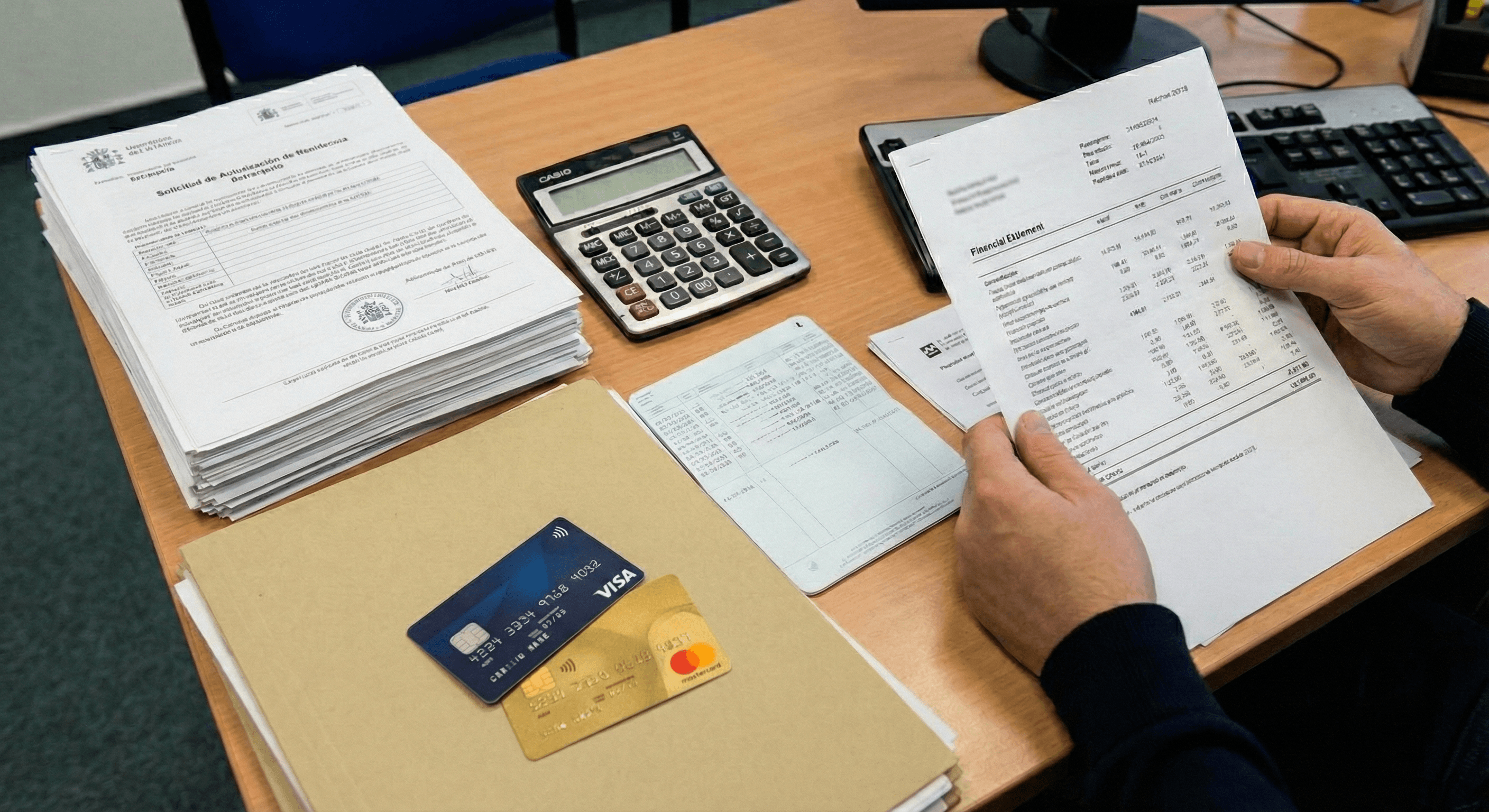
Financial means are a common requirement for some residence authorisations, which can be proven in various ways. At Traam, we already provide a calculator that helps you find the minimum amount to prove for different authorisations. In this blog post, we explore the topic in more detail: who must provide proof, how it can be proven, amounts, etc... We resolve the doubts you have!
👀 Who must provide proof?
In general, those foreigners who apply for a residence or stay authorisation in Spain and who are not dependents of the Spanish State must prove that they have sufficient financial means to support themselves and will not be a burden on the State.
That is to say:
Stay for studies: Although it allows for work up to 30 hours a week, you must demonstrate prior funds.
Non-lucrative residence: The most demanding case in terms of quantities.
EU Registration Certificate: For European citizens who do not work (pensioners, students or rentiers).
EU citizen family member card: When the European sponsor does not undertake work activity.
Family reunification (General Regime): The sponsor must show they can support their family.
Social roots: When an exemption from the labour contract is requested due to having ties or their own means.
As you can see, in many authorisations, it is requested that financial means, whether their own or those of the main family member, be accredited to prove the maintenance of the foreigner in Spain. To prove the resources, various means can be used to substantiate the availability of the required amounts for different authorisations.
💰 How can they be accredited?
The regulations allow for "any means of proof admitted in law". Obviously, this concept is very vague and not clear at all. Let’s shed a little light on the matter:
Bank certificates: This is the key document. It should include ownership, current balance, and, preferably, the average annual balance.
Credit cards: Accompanied by a bank certification indicating the available credit limit.
Property titles: Deeds for properties that generate income (rentals) or simply as assets.
Certified or manager's cheques.
Investment documentation: Investment funds, stocks, fixed-term deposits, etc...
⭐ ️Advice ⭐️
If you provide accounts from outside Spain, make sure that the certificate clearly indicates the currency and its equivalence in euros. For the equivalence in euros, it is advisable to include a printout of the official conversion from the Bank of Spain or the European Central Bank (ECB) as of the date of the application. If this is not possible, then attach the document proving the equivalence obtained from the World Bank.
Additionally, if the institutions issuing these documents cannot provide them in the necessary format (for example, the average annual balance), you can also prepare them with your own calculations through annexes. Remember to show the steps you have taken to arrive at the final numbers and make reference to where they came from. To do this, we recommend highlighting the relevant numbers in the original documents so that the Immigration Office official can easily verify that the requirements are met.
🎭 Whose financial means must it be?
Only the applicant themselves, or the family member sponsoring them in the case of family reunification, must be the owner of the funds. The only exception allowed is in the case of students. For these, the parents or legal guardians can be the ones financing the stay. In this case, it is not enough to send their bank statements; it is essential to present a public document, such as a sworn declaration before a notary duly legalised and translated, or a private one, such as a responsible declaration signed by all parties, indicating that the declarant takes responsibility for the student's expenses during their stay in Spain, where the family member formally commits to cover their expenses and return.
🏦 How much must be accredited?
The scales and criteria for determining financial means concerning immigration are various:
Non-Contributory Pension (pensión no contributiva),
Public Indicator of Multiple Effect Income (indicador público de renta de efectos múltiples),
Minimum Vital Income (ingreso mínimo vital).
In fact, as of today, the minimum vital income corresponds to 100% of the non-contributory pension. However, these amounts vary depending on the General State Budget Law which, in principle, must be revised and approved annually, but which, if for political reasons, there is no parliamentary consensus for its approval, the validity of the current amounts is extended. Currently, at the end of 2026, the parameters for 2025 apply.
The annual amounts for 2026 for the parameters are as follows:
Non-Contributory Pension: 8,803.20€
Public Indicator of Multiple Effect Income: 7,200.00€
Minimum Vital Income: 8,803.20€
You can also use our financial requirements calculator to find out the amount you need for your case.
💯 Must the entire amount be proven for the full duration of the authorisation?
The regulations state that it must be proven to have the means for the duration of one year, with some exceptions: in the case of the non-lucrative residence authorisation, although it does not have any impact initially, since the first temporary residence authorisation is granted for a period of one year.
Next, we will analyse some of the frequent particularities found in the most common authorisations.
🧑🎓 Students
Although initially, you are granted the authorisation for the duration of your studies, the reality is that the Foreigner Identification Card (TIE) will be issued for one year, renewable as long as:
you prove that you have completed the course and have passed the credits,
you are enrolled for the following year, and
you continue to have valid health insurance (public or private) and continue to have the financial resources to support yourself in Spain (for one more year).
Additionally, in this case, if the housing is paid in advance, as may be the case in a student residence, this can be provided as part of the financial means available for the stay in Spain.
🏖️ Non-Lucrative Residence
In the case of non-lucrative residence authorisations, it is required to prove having sufficient financial means to sustain yourself and your family members for the entire duration of the authorisation.
First authorisation: However, the first authorisation, which is a non-lucrative temporary residence authorisation, is granted for a period of one year, and must be renewed, after that year, for a period of four years.
Renewal: In that second application, proof must be provided of having the total income to sustain oneself, according to the established criteria, for the total of the four years.
Be careful! In the case of recurrent incomes, it must be proven that, for a minimally established period, these incomes have been received continuously, so that it can be expected that they will also be obtained in the short-medium term into the future.
🇪🇺 EU Citizens and Their Non-EU Family Members
When applying for permanent residency due to meeting specific requirements, that is, being in one of the legally stipulated situations, it will no longer be necessary to prove having financial means, as the Immigration Office presumes that financial stability will be maintained.
🔄 Recurrent vs. Fixed Income
There are some differences in how to prove financial means in the case of monthly or recurrent incomes, or fixed incomes:
Recurrent incomes: If you can demonstrate that you have recurrent incomes, you will not need to prove that you have the entire amount required for the year, only that you have been receiving them for some time in the past and that you will continue receiving them foreseeably into the future.
Fixed savings: However, if you do not have recurrent incomes, then you must present documentation proving that you have the full amount available to support yourself for at least the first year.
👑 Golden Recommendations
Safety Margin
We always recommend proving to have around 10-15% above the legal minimum to cover currency fluctuations and comfortably exceed the absolute minimum.
Last-Minute Incomes
Avoid "inflating" your bank account just before requesting the certificate. Immigration authorities require the average balance of the last months, or a bank statement from recent months, to see real stability.
Source of Funds
If money has entered suddenly, it is vital to attach proof of where it comes from (e.g. car sale contract, inheritance, or the liquidation of a deposit). It is likely that the Immigration Office will deny applications where a significant income appears suddenly without explanation, as they suspect it is "loaned money" just for the bank certificate snapshot.
Certificates Without a Stamp
Documents downloaded directly from online banking without a digital signature or stamp of the entity are often rejected. Make sure that the document is "official" and verifiable; a simple bank statement, for example, would not be sufficient.
Forgetting Family Obligations
If you travel with family, the amounts increase. It is not the same to prove funds for one person as it is for three.
Linking Health Insurance with Financial Means
In almost all cases where financial means are requested (students, non-lucrative, CUE or residence card for family of EU citizen in non-lucrative situations - student reasons), health insurance is also required. In these cases, both requirements are an indivisible package. It is of no use to demonstrate financial solvency if the insurance does not meet the requirements. Therefore, we recommend taking a look at our blog post What does health insurance consist of and how can I obtain it?
🌐 Is Legalisation and/or Translation Necessary?
Bank or financial documents are private and do not require legalisation. Public documents such as records of declarations or sworn declarations before a notary, pension certificates, etc… must be legalised. Furthermore, any documents not in Spanish must be translated.
As for bank documents, in some cases, you can request the entity itself for a translated version of the document. In other cases, some immigration offices accept documentation issued in English, as long as the bank, account holder, average balances, in euros or similar currency like dollars, can be easily interpreted. However, if you want to be safe we do not recommend this option.
If you want to take a bit more risk, you can try submitting the document in English, and in case they require the translation through a requirement from the immigration office, proceed with the translation. Keep in mind that responses to requests must be made within 10 days, which is quite tight and leaves little room. If you want to be safe, then review the methods of legalisation and translation.
If you want more information on methods of translation and legalisation, you can check the specific section of our website dedicated to this topic.