NIE, TIE, EU Citizen Registration Certificate?
We clarify what they are and what their differences are.

5 mins
🔢 Foreign Identification Number
❓ What is the NIE?
The NIE is a personal, unique, and permanent code assigned by the General Directorate of Police to foreigners who need to carry out any administrative, tax, or economic procedure in Spain.
🤔 Who can obtain it?
Any foreigner, whether they are a Union citizen or from outside the EU.
🔍 How can I identify it?
The format of the NIE is very recognisable. It is a code that always starts with a letter X, Y, or Z, followed by 7 more digits, and a letter that serves as a final control digit.
Example: Y-1234567-R.
👀 Do you want to know a fun fact?
We are going to explain where the final letter of a NIE comes from.
1️⃣ Replace the first letter of your NIE with one of these values X=0, Y=1 and X=2, as appropriate.
2️⃣ When you obtain the number (which will start with 0, 1, or 2 followed by the 7 digits of your NIE) divide it by 23, remove the decimals (result A), and then multiply by 23 to obtain the second result (result B).
3️⃣ Subtract the result A-B, and find the equivalence of the result according to these references: 0=T 1=R 2=W 3=A 4=G 5=M 6=Y 7=F 8=P 9=D 10=X 11=B 12=N 13=J 14=Z 15=S 16=Q 17=V 18=H 19=L 20=C 21=K 22=E.
As you will see, this final control digit allows different entities to verify that your NIE is valid and is written correctly.
⚙️ How can I obtain a NIE?
There are two ways to obtain a Foreign Identification Number (NIE):
By personal request: If you request it voluntarily, you will receive the NIE assignment certificate (“white paper” of A4 size) with your details and your number. You can also receive it printed on a Spanish visa, as well as in an initial residence resolution.
Automatically: It is not always necessary to request the NIE to have one. Sometimes, the Government automatically assigns it when a foreigner interacts with them. A common example occurs if the police imposes a fine on a foreigner identified with a passport; the system will generate a NIE for them, if they do not already have one, to process the fine, even if the person did not request it.
📍 How and where can I apply for it?
You do not need any residence/work authorisation in Spain to apply for a NIE and you can request it both:
🇪🇸 From Spain: At the Foreigners' Offices or Police Stations (with an appointment), in person or through legal representation with a notarial power.
🌎 From abroad: Through the Spanish consular office or diplomatic mission in your country of origin/residence, in person or through a legal representative with a notarial power.
🛠️ What is it for?
The NIE is necessary to carry out any type of procedure, whether of an economic, tax, legal, or social nature.
🏠 Economic: Buying a home, opening a bank account, buying a car, etc…
💰 Tax: Registering with the Tax Agency, paying and settling taxes, etc…
⚖️ Legal: Signing a work contract, accepting an inheritance, setting up a company, etc…
👥 Social: Registering with Social Security, etc…
Without a NIE, you are invisible to the Spanish authorities.
🏠 Does the NIE grant the right to reside?
No, absolutely not. Having a NIE alone does not grant you permission to stay, reside, or work in Spain.
⏳ Does the NIE have validity, expire, or change?
No, the NIE, as such, the number does not expire or change. You will always have the same one, and it will accompany you for life. However, the certificate (“white paper”) that certifies the NIE has a validity of 3 months from its date of issue.
📝 Where is it registered?
Your details are registered in the Central Register of Foreigners.
👤 Are there different types of NIE?
This is where the biggest confusion arises. The number is the same, what changes is the physical document where it is delivered and the reason for which it is given:
Non-Resident NIE (“white paper”): It is the “non-resident NIE” which is recognisable as it is printed on an A4 “white paper” and is intended for those who do not plan to live in Spain for more than three months but do need to carry out a specific administrative procedure. The document usually has a validity of 3 months, although the number itself never expires and is assigned to a person for life.
Resident NIE (popular concept): Technically, there is no “resident NIE document”. What happens is that when you obtain residency, your NIE number is printed on the document certifying your residence. These are:
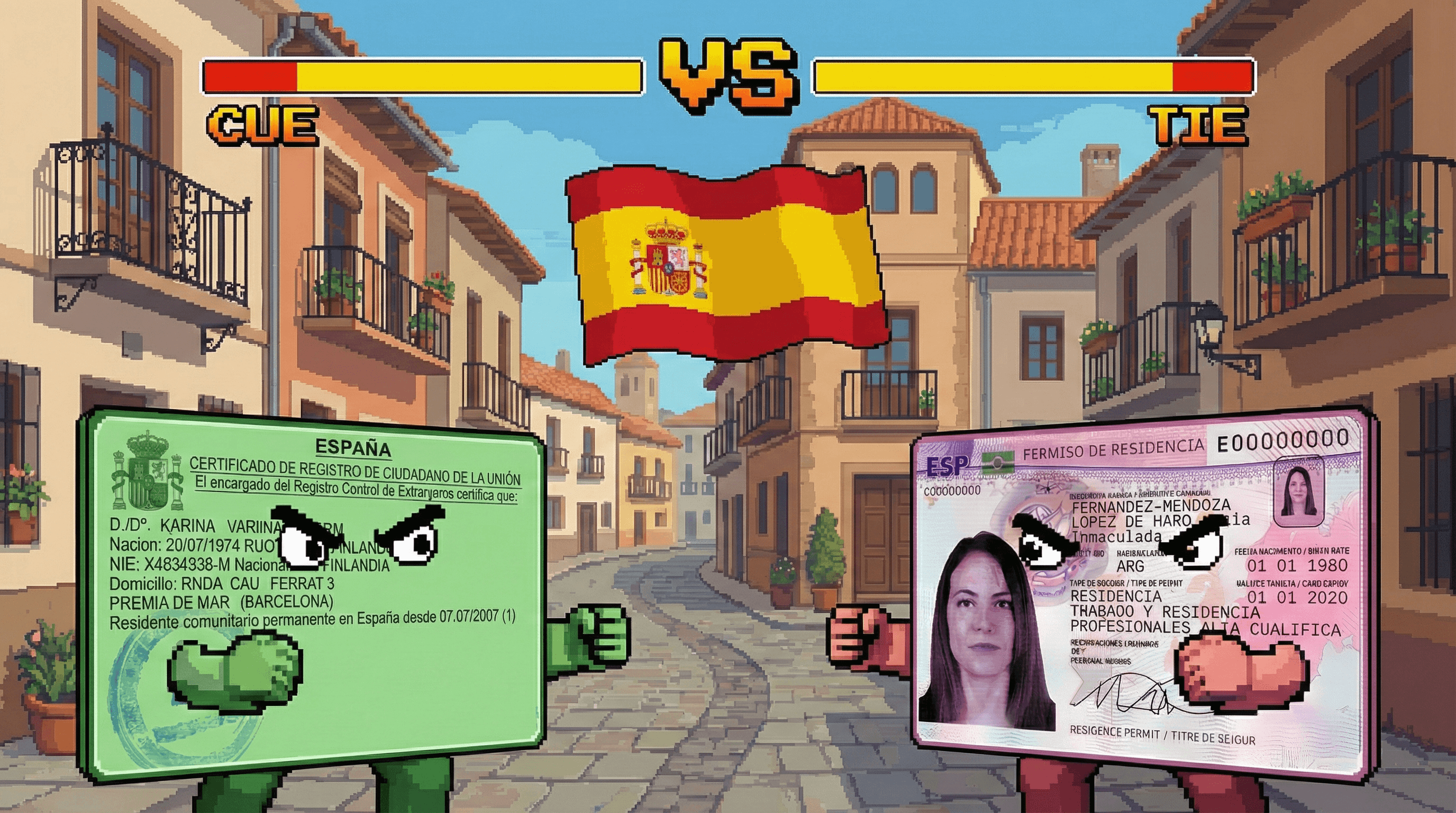
EU Citizen Registration Certificate (“green card” or CUE) for EU citizens.
Foreign Identity Card (TIE) for non-EU citizens.
Next, we will delve a little deeper into these two documents that Traam can help you obtain. Click on the following links to learn about their requirements:
🇪🇺 EU Citizen Registration Certificate
❓ What is the CUE?
The EU Citizen Registration Certificate, also known by its initials CUE, is a non-identifying document that certifies the legal residence in Spain of citizens from countries of the European Union, the European Economic Area (Norway, Liechtenstein, or Iceland), or Switzerland.
🤔 Who should request it?
EU citizens who want to reside in Spain for more than 3 months.
🔢 Does the CUE contain a NIE?
Of course. The CUE is popularly known as the “green card”. It is a green paper card, laminated, that contains the name, surname, citizenship, address, and, most importantly, your Foreign Identity Number (NIE). The CUE does not contain a photograph.
🆔 Can it be used for identification?
No, the CUE is not an identification document. For any official procedure, signing contracts, or traveling across borders, you must always carry the CUE accompanied by your passport or national identity document from your country of origin. The CUE alone does not prove who you are; it only shows that you reside here legally.
🛠️ What is it for?
It has the same practical functionalities as a NIE, but with an added value: it certifies you as a resident in Spain.
🏠 Does the CUE grant the right to reside?
The European citizen already has the right to reside in Spain, as it is an inherent right granted by the treaties of the European Union. The CUE does not “grant” you the right; it verifies and certifies to the Spanish authorities that you are exercising that right that you already possess.
⏳ Does the CUE have a validity period or does it expire?
Unlike the foreign identity card (TIE), which we will see later, the CUE does not have an expiration date printed, so it does not expire. However, there are two modalities:
Initial, granted at the beginning and certifies your residence.
Permanent, after five years of legal and continuous residence, you acquire the right to permanent residence and can request that your certificate reflects this explicitly.
📝 Where is it registered?
Your details are registered in the Central Register of Foreigners.
🫴🏼 How can I request it?
The issuance is the exclusive competence of the National Police Force and requires a prior in-person appointment. It can be a bureaucratic process if you do not know the exact documentation to provide.
With Traam you can initiate the procedure to ensure everything goes perfectly the first time round, visit our CUE page and find out more!
🪪 Foreign Identity Card
❓ What is the TIE?
The Foreign Identification Card (also known by its abbreviation “TIE”) is the unique and non-transferable physical document that certifies legal stay or residence in Spain. Unlike the EU Citizen Registration Certificate (“green card” or “CUE”), the TIE is exclusively directed at non-EU citizens (i.e., people from outside the EU, EEA, or Switzerland).
🤔 Who should request it?
It should be requested by non-EU foreigners who have a stay/residence/work authorisation in Spain for more than 90 days.
Therefore, the basic rule is:
🇪🇺 If you are an EU/EEA/Swiss citizen 👉🏽 EU Citizen Registration Certificate (“green card”).
🌎 If you are NOT an EU/EEA/Swiss citizen 👉🏽 EU Citizen Identity Card (TIE).
🔍 How can I identify it?
The Foreign Identification Card (TIE) is very similar to the Spanish DNI. It is a rigid plastic card that contains your name, surname, citizenship, address, of course, the NIE and, unlike the EU Citizen Registration Certificate (“green card” or “CUE”), it also contains a photograph and an electronic chip.
🔢 Does the TIE contain the NIE?
Yes, and the difference is that the NIE is simply the personal identification code, unique and permanent, and the TIE is the physical card that contains the NIE, among other identifying data.
🛠️ What is it for?
It has the same practical functionalities as a NIE, but with an added value: it certifies your stay or legal residence in Spain.
🆔 Can it be used for identification?
No, although it contains your photograph and is associated with your fingerprint, the TIE is not an identification document as such, as the DNI or a passport are. However, you can use it without the need to present your passport for your procedures in Spain. In contrast, to cross borders and travel, both within and outside the Schengen Area, it is essential to carry your passport along with the TIE.
⏳ Does the TIE expire? What are the consequences?
Yes, unlike the NIE that never expires, the TIE has an expiration date. The validity depends on the permit you have been granted.
‼️ Very important: You must pay attention to the expiration date printed on the TIE to start the renewal before it expires. If the TIE expires, you fall into an irregular situation and thus lose your permission to stay, reside, and/or work in Spain, which means being in a very precarious and complicated situation if you want to continue living in Spanish territory.
🫴🏼 How can I request it?
The issuance of the TIE is the exclusive competence of the National Police Force. It is a mandatory in-person process because it requires fingerprinting. Keep in mind that you must request your TIE within a month, from your entry into Spain with the corresponding study/residence/work visa or from when you were notified of the favourable resolution of your study/residence/work authorisation.
It can be a bureaucratic process if you do not know the exact documentation to provide, but with Traam you can ensure everything goes smoothly to get it right the first time, visit our TIE page and find out!
To conclude the blog, and illustratively, the NIE is like the account number, it is just a number, and the TIE is like the credit card, it is the plastic that allows you to operate and that expires after a certain time, although the bank account number remains the same.